


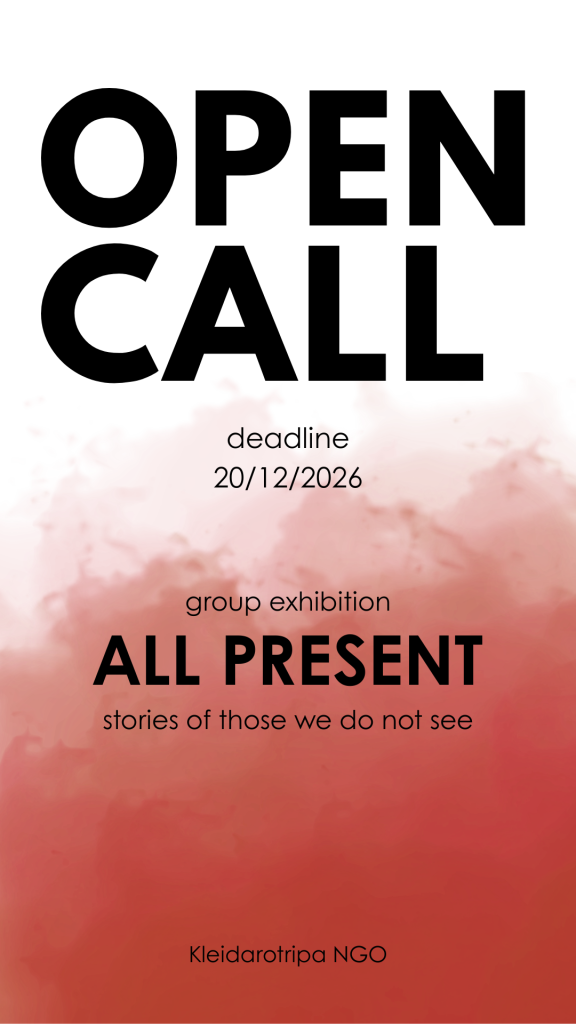
All Present. Stories of those we do not see · Kleidarotripa NGO · Spring 2027
Kleidarotripa NGO invites visual artists to take part in a group exhibition that begins with objects people have donated to the organisation. Each artist will choose one object, without ever learning who it belonged to, and will create from it a new work for those whom society leaves out of the frame. Spring 2027, at Kleidarotripa’s new space in Kallithea, Athens.
Applications are free of charge and are accepted only by email to project@amkekleidarotripa.gr, with the subject line “Application All Present – Full Name”. .
Please include:
You may send the above either in the body of the email with the images attached as jpg files, or gathered in a single PDF of up to 10 MB. We do not ask for a project proposal. The proposal will follow once you have chosen your object.
All applicants will receive a reply by 15 January 2027.
Selected artists pay a participation fee of €30 and must attend the object selection meeting in Kallithea in person.
For questions: project@amkekleidarotripa.gr
Every day, Kleidarotripa turns its gaze towards people whom society leaves out of the frame. The exhibition follows the same movement and speaks about those we do not see. The person who is forgotten, who is missing, who works without being seen, who grows old and stops being counted, who remains outside the frame. The title “All Present” is the answer: the words heard at roll call when everyone has answered to their name. We are not looking for works that illustrate a social problem. We are looking for works that start from a specific object and leave the viewer with one question: who am I not seeing?
At Kleidarotripa’s new space in Kallithea, Athens, in spring 2027. The exhibition will not take place in a gallery, and this is a deliberate choice. The works return to where the objects came from, in front of the people who gave them and the public that supports the organisation’s work. After its first presentation at Kleidarotripa, the exhibition may travel, in full or in a smaller form, to other cities and events. Each artist’s participation in later presentations will be agreed separately.
Visual artists working in any medium and at any stage of their career: painting, sculpture, installation, assemblage, photography, mixed media and more. Up to ten artists will take part in each of the exhibition’s five thematic strands. The final number will depend on the applications received and the coherence of the exhibition. Attendance in person at the object selection meeting in Kallithea is required (the date will be announced after the call closes and participants have been selected).
Applications are assessed on the quality and consistency of the work, its relation to the idea of the exhibition, and the applicant’s openness to collective work. All applicants will receive a reply by 15 January 2027.
Applying is free. Selected artists pay a participation fee of €30 into the NGO’s bank account, covering curation and coordination. All production and promotion costs of the exhibition are covered by Kleidarotripa NGO. The works remain the property of the artists. In the event of a sale, at least 10% goes to Kleidarotripa’s activities. Each artist may choose to give a larger percentage.
Stage | Date |
Application deadline | 20 December 2026 |
Selection results | by 15 January 2027 |
Meeting and choice of objects | to be announced |
Delivery of works | to be announced |
Opening | to be announced |
Each artist will receive an object that someone donated to Kleidarotripa NGO and will make a new work from it. We do not know who it belonged to or what its story was, and we will not find out. This is a choice: the object comes to you as a blank page, and the story you give it is your own.
We are not asking you to recycle something old or to illustrate a social issue. We are asking you to look at the object long enough for it to raise a question, and to answer that question in your own language.
The exhibition will be shown in spring 2027 (final dates to be announced) at Kleidarotripa’s new space in Kallithea, Athens. It is not a gallery, and this is a choice. The works return to where the objects came from, and the first to see them are the people who gave them and those who support the organisation’s work. After the first presentation, the exhibition may travel, in full or in a smaller form, to other cities and events.
The organisation’s name is not accidental: kleidarotripa means “keyhole” in Greek. Through a keyhole you see a little, through a narrow opening, of something that usually stays closed. This is what Kleidarotripa does in its daily work: it turns its gaze towards people whom society has left out of the frame. Prisoners waiting for a book, women in shelters, families who cannot make ends meet, a kindergarten in a remote village. And it does so through things, objects that someone parted with so that someone else could use them.
The exhibition follows the same movement and has a single theme: invisibility. We live in a time when everything is photographed and everything is posted, and yet many people are not seen anywhere. The elderly person who lives alone, the woman who cares for others without being paid, the man sleeping on the pavement whom we walk past, anyone behind bars or behind a closed door.
The objects in the exhibition are invisible too, in two ways. The person who gave them remains anonymous and their story unknown. The artists do not recover that story, they invent it. This is the wager: if we can imagine a person behind a shoe, perhaps we can also see the one walking past us.
The five strands thus become five ways in which someone stops being seen. They are forgotten (Memory).
They are absent, and only the mark of their body remains (Trace).
They work without their work being counted (Hand).
They grow old and stop being taken into account (Time).
They remain outside the frame (Gaze).
The exhibition does not want to speak on anyone’s behalf. It wants to return a simple question to the viewer: who am I not seeing?
The objects are divided into five groups. They are not five separate exhibitions but five sides of the same story. Up to ten artists will take part in each strand. The final number will depend on the applications received and the coherence of the exhibition.
Memory. Photographs, postcards, keepsakes. What do we hold on to, and what do we let be lost?
Trace. Clothes, shoes, nightgowns. The body is missing, its mark remains.
Hand.Embroidery, doilies, handicrafts. Work that was done without anyone seeing it.
Time.Clocks, old appliances, things from other eras. What has changed, in us and around us?
Gaze. Cameras, picture frames. What enters the frame, and who is left outside it?
The questions are starting points, not topics you have to cover.
The medium, the style and the interpretation are free. Painting, sculpture, installation, assemblage, photography, text, sound, whatever suits you. You can transform the object, incorporate it, cut it into pieces, or leave it untouched beside something new.
Only three things are shared by all. The work starts from one object from Kleidarotripa, and only one. The object, whole or in pieces, must be physically present in the final work. A photograph of the object as it was received will be shown next to the work, so that the viewer can see where you started even if its form has changed. And the work stays within the dimensions set out below.
You may add materials of your own. The object, however, must remain the core of the work, not a detail.
A preselection of objects will be made, roughly twice as many as the number of artists, already divided into the five strands. Each object is numbered and has been photographed as it was received. This photograph will accompany the work in the exhibition.
Only objects that cannot be passed on to people in need are used, because they are worn, broken or no longer usable. Anything that can help someone goes there first.
You make the choice yourself, at the meeting at Kleidarotripa, holding the objects in your hands. Choose the one that raises a question for you, not the most beautiful one. If two artists want the same object, we will discuss it on the spot.
In photographs showing recognisable faces, the faces will not appear clearly in the final work, out of respect for people we cannot ask.
About two to three months pass between choosing the object and delivering the work.
Dimensions.The work must not exceed 100 × 100 cm and must be portable by one person. If you are thinking of something larger or an installation in the space, please talk to us before you start.
Delivery and transport.Each artist brings and collects their own work. Works should arrive ready to hang or display.
The work belongs to the artist.If it is sold, at least 10% goes to Kleidarotripa’s activities. You may choose to give a larger percentage. In this way the object that was given to help, helps again.
Photographs and communication.By taking part, you agree that photographs of your work, with your name, may be used to promote the exhibition and in applications for its future presentations.
Costs. By taking part, you agree that photographs of your work, with your name, may be used to promote the exhibition and in applications for its future presentations.
All of the above will be set out in a short one-page agreement that we will sign together.
The curatorial role is to keep a balance between the strands and coherence across the whole, not to correct works. If an idea does not fit the framework, we will discuss it early, at the first idea stage, so that no work is wasted.
The curator also takes part with one work, on the same terms as everyone else.
All communication takes place only through the exhibition’s email, project@amkekleidarotripa.gr, so that nothing gets lost.
Designed and Created by Vadorio
Copyright © 2024 All rights reserved